An agent that never stops looking — and never acts for them.
Pathfinder searches continuously across UCAS, apprenticeship vacancies, university course pages and employer portals, learns what fits a particular student, and brings opportunities to them with reasons attached. This page is the detail for the people who advise students: where the information comes from, where the line is drawn on what it will and won't do, and what sits underneath it. Students get a 45-second version, and parents and carers get a plain-English one.
The problem isn't too few options. It's that no one is watching for you.
A 17-year-old applying to university or apprenticeships in the UK is asked to do something genuinely difficult: hold a strategy in their head while moving between fifteen websites that don't talk to each other. UCAS, university course pages, GOV.UK's apprenticeship search, employer career sites, college advice, half-remembered Open Day dates, a referee who needs an email, a deadline that may have moved.
The task isn't really searching. The task is not missing things, the apprenticeship that posted on a Tuesday morning while you were in a Maths lesson, the Open Day that would have changed your mind, the deadline missed by three days because the form needed a reference you hadn't asked for yet.
Search engines hand you ten blue links. They don't notice when something new appears. They don't know your predicted grades, or that you're cost-sensitive, or that last week you said you were done with pure maths. They don't remember.
"Pathfinder remembers. And it keeps looking, even when you're not."
What the agent does while you sleep.
You begin with a conversation. Not a form, a conversation. You tell Pathfinder what you're studying, where you are, what you're predicted, what you're drawn to, what you're worried about. You don't have to know what you want. Most 17-year-olds don't, and Pathfinder is built around that fact rather than against it.
From that conversation it builds a picture of you, predicted grades, subject strengths, location preferences, financial constraints, the softer texture of what you're hoping for. That picture becomes the lens through which it sees every opportunity it finds.
Then it goes to work. It indexes UCAS-style courses and apprenticeship vacancies, ranks them against you, and re-ranks them as you change. It notices the deadline you haven't acted on, the Open Day you'd want to attend, the apprenticeship that opened at 9am, the degree apprenticeship that quietly solves a worry you mentioned three weeks ago. When it finds something, it brings it to you with reasons, why it fits, where it's risky, what it would take, what to do next.
Underneath, the looking runs as loops: default ones Pathfinder keeps for every student, for deadlines, discoveries, wildcards and new sources, and ones the student adds for themselves. When a loop finds something, the student gets a notification with the reason attached, rather than finding out too late.
A real plan. Not a list.
Most search tools give you results. Pathfinder gives you a strategy. Every plan is shaped around how applications actually go: one main choice, three Alternates that protect the student if grades, interviews or places don't go to plan, and one wildcard, an opportunity adjacent to what they've been looking at, surfaced because they might not have known it existed.
Routes aren't either/or. A student can be all in on UCAS and still carry an apprenticeship among their Alternates, or the reverse, with further education kept in view as a backup. Options sit on a map, so distance from home is part of the picture. And when a key date passes without a positive result, results day included, Pathfinder brings the Alternates and the wildcard forward and talks it through with the student. Nothing switches without them.
The wildcard is often the most valuable suggestion. The degree apprenticeship for the cost-sensitive student. The foundation year for the late bloomer. The Manchester course for someone who said London but would actually love Manchester if they let themselves consider it.
"A good agent doesn't just give you what you asked for. It tells you what you'd want if you knew what was out there."
A plan that keeps itself current.
Every saved option brings its dates with it: closing dates, Open Days, results day, portfolio deadlines, and the nudge to ask a teacher for a reference while there's still time to ask. They sit in one list, each marked confirmed, approaching, changed or needs checking, so a student can see at a glance what's settled and what to verify.
Loops watch those dates as well as new opportunities. When a date moves or a deadline gets close, the student hears about it in time, and when one passes without the result they wanted, their Alternates are already waiting.
Where there's writing to do, a personal statement section or a "Why this course?" answer, Pathfinder can help draft from what it already knows. The student edits. The student decides what's true. The student sends.
"Pathfinder does the work of keeping the plan alive. You do the work of being the person at the centre of it."
What Pathfinder won't do.
Pathfinder doesn't submit applications. It doesn't pay fees, accept offers, withdraw applications, or send emails as the student. It doesn't invent grades or pretend a recommendation is a guarantee. It tells you when something is risky, and it tells you why.
The agent does a lot of work behind the scenes, searching, ranking, planning, drafting, watching deadlines. None of that work crosses the line into making decisions that are yours to make. Every shortlist, every draft, every date and every suggestion is something the student can review and override.
"An AI that submits things on your behalf is the wrong shape of tool for a moment in someone's life that genuinely is theirs."
It gets more efficient with every student.
Pathfinder is useful with one student. It is significantly more useful with a thousand. When a single student is searching, the agent searches on their behalf, already better than searching alone. When a thousand are searching, the agent searches once and routes the results intelligently. A new apprenticeship posted at 9am isn't discovered a thousand times by a thousand browser tabs; it's discovered once and matched against a thousand profiles. The students it fits hear about it. The students it doesn't aren't interrupted.
The web doesn't get bigger when more students search it, only the duplicated effort grows. An agent that searches centrally and matches individually scales without scaling the work.
What it shares is the searching, never the students. A student's plan, chats and choices are used to run their plan and nothing else: they aren't sold, used for advertising, or used to profile them for anything outside it.
"Helping one student is useful. Helping many students is genuinely transformative."
Built for students. Visible, with consent, to the people who help them.
Pathfinder is designed first for the 17-year-old at the centre of the process. Everything else flows from there. But applications aren't a solo activity, even when they feel like one. Parents want to know there's a backup plan. Advisors want to spot the students who are under-aspiring or at risk of missing deadlines. Teachers want to write references for students whose strengths they actually understand.
With the student's consent, a parent, guardian or advisor can be linked to a read-only view of their plan: where it stands and the dates coming up. It is never a surveillance tool and never a way of taking over the process. Linked adults don't see private chats, and the student can withdraw consent at any time. Parents and carers have their own page.
Where the information comes from.
The most reasonable question an advisor asks about any AI tool is whether it is making things up. Pathfinder answers that in the interface rather than in a policy document: results carry their source, and the student can open it.
When it presents options, it names where each came from and links out to the original listing. A student who wants to check is one tap from the actual page. A teacher who wants to verify a claim does not have to take the agent's word for it, and neither does the student.
This also shapes what the agent is willing to say. Where it cannot evidence something, it says so rather than filling the gap, and where a recommendation is a stretch, it is labelled as one. The honest downside is presented alongside the reason it fits, not buried under it.
"A student should never have to wonder whether the thing in front of them is real."
What sits underneath it.
Pathfinder is not a prompt wrapped around a chatbot. It runs on Pea, a governed agent runtime built so that every tool call, retrieval and external request happens inside a bounded, auditable structure. The agent can propose. It cannot quietly grant itself permission to act.
That distinction is the reason Pathfinder can be trusted around a 17-year-old's application year. The limits described in section 05 aren't promises made in marketing copy, they are enforced below the level the model can reach. An agent that is asked nicely not to submit an application is a different kind of product from one that cannot.
Each student's work runs in its own isolated worker, with authentication handled separately from the application itself, and stored state kept apart from the reasoning that reads it.
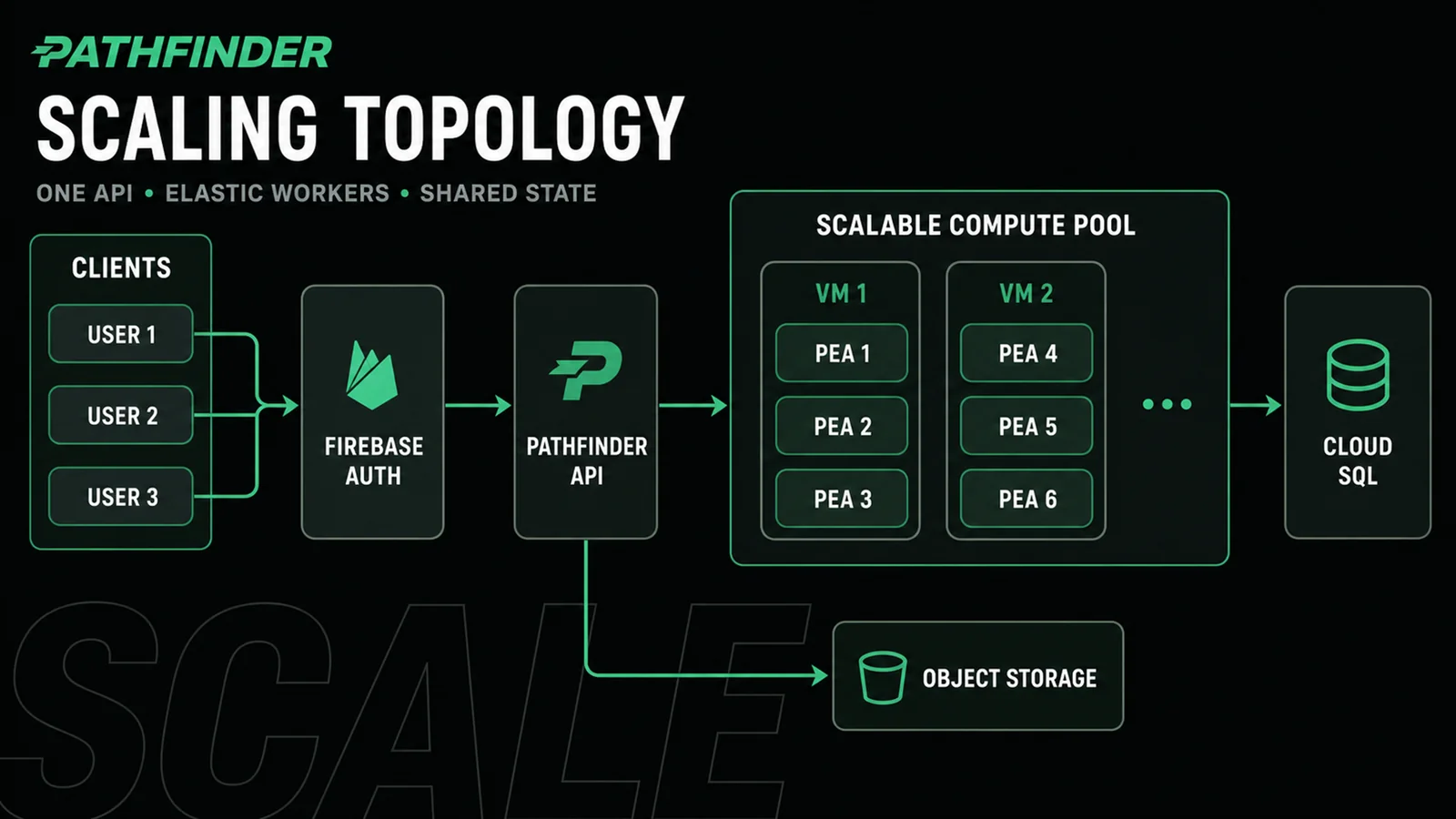
Scroll the diagram sideways to read it.
Starting small on purpose.
The first version of Pathfinder is deliberately narrow: UK students aged 16 and over, A-levels, and university, apprenticeship and further education options, one application cycle. Application advice that tries to serve everyone tends to serve no one.
Beyond the first cycle, the product extends naturally. More routes, Scotland, Wales, Northern Ireland, and their separate systems. More qualifications, BTECs, T-levels, the IB.
Next up: an Android app, and dates that sync to the student's own calendar. Then more moments in the journey, Open Day planning, interview preparation, Clearing in real time. More people in the loop, schools, colleges, advisors, employers, each with their own surface, none of them in charge of the student.
What stays constant is the shape of the agent: always on, always learning, always bringing opportunities back to the person at the centre.